The retail and e-commerce landscapes have undergone a massive transformation in how consumers prefer to pay. If you are operating a growing brand in 2026, you have likely noticed that the checkout page is no longer just a place to collect credit card information—it is a strategic conversion engine.
As the global market for deferred payments surges past a gross merchandise volume (GMV) of $560 billion, the concept of a buy now pay later small business strategy has shifted from a novel experiment to a fundamental requirement. By the end of this year, provider revenues in this space are projected to reach $54.56 billion, driven by an expanding user base of nearly 400 million active shoppers globally. For merchants, this is not just about consumer convenience; it is about protecting your margins, increasing cart sizes, and acquiring new customers.
But with merchant fees that can sometimes run double those of traditional credit card processing, the decision to implement these tools requires careful consideration. In this comprehensive guide, we will break down exactly what Buy Now, Pay Later means for your bottom line, how to evaluate top BNPL merchant solutions, and whether integrating platforms like Klarna or Afterpay makes mathematical sense for your store.
What is Buy Now, Pay Later and How Does It Work?
At its core, Buy Now, Pay Later (BNPL) is a point-of-sale financing option that allows customers to split the cost of their purchase over a set schedule, typically with zero interest attached to the consumer if paid on time.
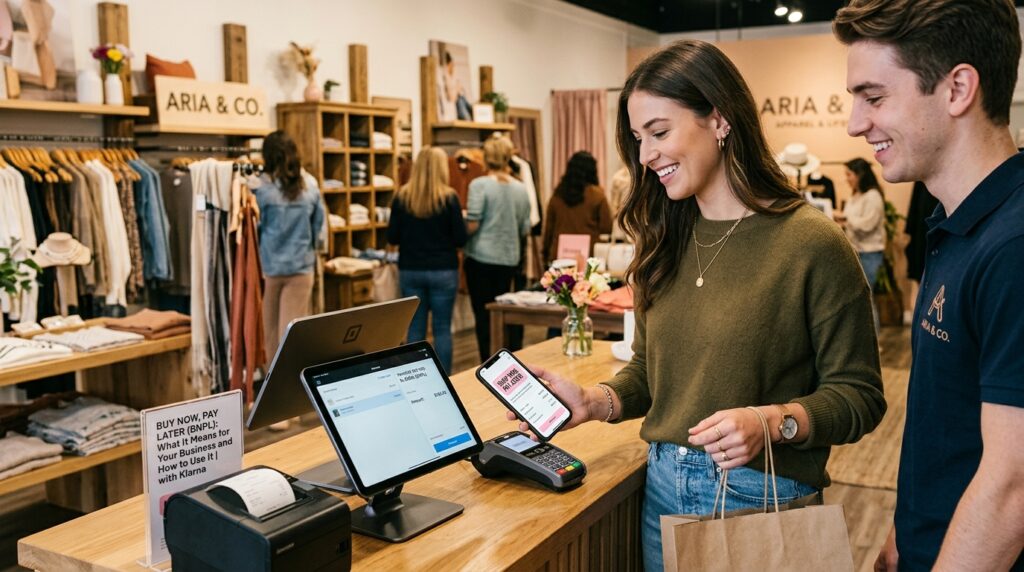
The most common model is the “Pay in 4” structure. When a shopper reaches your checkout, they pay 25% of the total order value upfront using their debit or credit card. The BNPL provider then bills them for the remaining 75% in three equal installments, usually spaced two weeks apart.
Here is why this mechanism is revolutionary for merchants: you get paid upfront.
When a customer checks out using a BNPL service, the provider pays your business the full purchase price immediately (minus the agreed-upon merchant fee). You do not take on the risk of collecting those future installments. If the customer defaults, misses a payment, or suffers from a frozen bank account, the BNPL provider absorbs that loss, not your business.
For a small business owner, this means you can offer financing to customers without acting as a bank, taking on credit risk, or chasing down accounts receivable. The provider handles the underwriting, the risk assessment, the compliance, and the collections. You simply fulfill the order.
The Business Case: Why Offer BNPL?
If you are paying 2.9% + $0.30 for standard credit card processing, seeing a BNPL fee structure of 4% to 6% per transaction might induce sticker shock. Why would a margin-conscious business willingly pay a higher gateway fee?
The math works because BNPL fundamentally alters consumer psychology at the point of purchase. Here is the concrete return on investment (ROI) that justifies the premium:
1. Significant Increases in Average Order Value (AOV)
When a customer views a $200 jacket, the immediate hit to their bank account causes friction. When that same jacket is presented as “4 interest-free payments of $50,” the perceived affordability skyrockets. In 2026, retail data consistently shows that businesses implementing BNPL see their Average Order Value increase by 15% to 40%. Customers are more likely to add complementary items to their cart when the immediate financial burden is divided.
2. Higher Checkout Conversion Rates
Cart abandonment is the silent killer of e-commerce profitability. Shoppers frequently load up carts only to bail out when confronted with the final total. By displaying BNPL options early in the shopping journey (often right on the product description page), merchants reduce checkout friction. Consumers who know they can spread payments are significantly more likely to complete the transaction.
3. Access to High-Intent Acquisition Channels
In 2026, younger demographics—specifically Gen Z and Millennials—actively seek out BNPL as a budgeting tool rather than a debt vehicle. Many do not own traditional credit cards by choice. Furthermore, BNPL is no longer just for low-income brackets; adoption among high-earners has surged as they utilize interest-free capital. Providers like Klarna have built massive consumer applications that function as discovery shopping engines. Being listed in these provider directories can drive high-intent, net-new traffic directly to your storefront.
Evaluating BNPL Merchant Solutions: The ROI Math
Before you sign a contract, you must ensure that the incremental revenue generated by the service outweighs the higher transaction fees. The premium you pay to a BNPL provider is only justified if it generates enough conversion lift or AOV expansion to offset the spread versus standard card processing.
For example, if your standard processing fee is 2.5% and the BNPL fee is 5.5%, you are paying a 3% premium on that transaction. If the BNPL option simply cannibalizes a sale that would have otherwise happened via a standard credit card, you lose margin. However, if that BNPL option caused the customer to spend $150 instead of $100, or saved a sale that was about to be abandoned, the math swings heavily in your favor.
To help you visualize whether the math works for your specific margins and traffic, you can use the interactive simulator below:
Interactive visual ready
Klarna vs. Afterpay: A 2026 Comparison
If you have decided to move forward, you will quickly find that the market is dominated by a few major players. For merchants running on modern commerce stacks (like Shopify, BigCommerce, or headless setups), the decision often comes down to two titans. Here is a breakdown of Klarna for small business versus Afterpay for merchants.
Afterpay: The King of Simplicity
Afterpay has built its massive brand loyalty by sticking strictly to a single, highly recognizable core product: the “Pay in 4” model.
The Product: Customers pay 25% at checkout and three additional payments every two weeks. There is absolutely no interest charged if the customer stays on schedule.
Late Fees: Unlike some competitors, Afterpay does charge late fees, but they are strictly capped (currently at 25% of the order value or $8 per missed payment, whichever is lower). If a shopper misses a payment, their Afterpay account is immediately paused, preventing them from accumulating a debt spiral.
Merchant Fit: Afterpay is exceptionally strong in the fashion, beauty, and lifestyle apparel sectors. If your average order value sits between $50 and $300, and your target demographic values absolute transparency and strict budgeting tools without credit checks, Afterpay is incredibly effective. Its brand presence at checkout is heavily trusted by Millennial shoppers.
Klarna: The Omnichannel Ecosystem
Klarna operates on a much larger global scale, boasting over 150 million active consumers and a presence in over 45 countries. It is less of a single payment tool and more of a comprehensive commerce ecosystem.
The Products: Klarna offers three distinct tiers. Pay in 4 operates identically to Afterpay. Pay in 30 allows a customer to defer the entire payment for 30 days with no interest, letting them try items at home before parting with cash. Financing offers traditional 6 to 36-month installment plans (with interest) for high-ticket items.
Network Effects: Klarna’s standalone consumer app functions as a daily shopping destination. Merchants integrated with Klarna get their products surfaced inside the Klarna app, which acts as an entirely separate customer acquisition channel.
Merchant Fit: Klarna is ideal for businesses with varied product catalogs. If you sell a mix of $40 accessories and $1,500 furniture pieces, Klarna’s ability to dynamically offer “Pay in 4” for the small items and “36-month Financing” for the large items makes it incredibly versatile. It is also the superior choice for merchants with a heavy European or international customer base, where Klarna’s market penetration is dominant.
How to Implement BNPL on Your Store
Integrating a BNPL solution is no longer a massive technical undertaking. For most modern e-commerce platforms, it is a plug-and-play process.
Select Your Partner and Negotiate: Reach out to the providers. If you have significant existing volume, do not accept the standard baseline rate—merchant fees in the 4-6% range can often be negotiated down if you can prove high traffic and low return rates.
Enable the Payment Gateway: On platforms like Shopify or WooCommerce, enabling Klarna or Afterpay is often as simple as installing an app and linking your merchant account credentials.
Implement Upstream Messaging: This is the most crucial step. Do not wait until the checkout page to reveal your financing options. You must install the provider’s on-site messaging widgets so that dynamic text (e.g., “Pay as low as $25/mo”) appears directly under the price on your product detail pages. This upstream messaging is what actually shifts consumer behavior and drives the AOV increase.
Update Your Policies: Ensure your return policies explicitly mention how BNPL refunds are handled, as the provider will need to reverse the loan on their end when you process a refund in your dashboard.
Best Practices and Potential Pitfalls
While the benefits of BNPL are substantial, small business owners must navigate a few inherent risks to maximize profitability.
Monitor Return Fraud: Because shoppers are only parting with 25% of the cash upfront, some consumer segments use BNPL to order multiple sizes or colors of an item with the strict intent of returning most of them. If you are paying a 5% fee on the original large transaction, and you process a massive return, the BNPL partner often does not refund that original merchant fee. High return rates can quickly eat into your BNPL profits.
Watch Your Approval Rates: Not every customer who applies for BNPL at your checkout will be approved. If your chosen provider runs tight credit algorithms and denies 40% of your shoppers, those customers may abandon the cart entirely out of frustration. Ask providers for average approval rates in your specific industry category before signing.
Customer Service Disconnects: When a customer has an issue with their payment schedule or a late fee, they must deal with the BNPL provider’s customer service, not yours. If the provider’s support is poor, the customer will inevitably associate that negative experience with your brand. Choose a partner with a strong reputation for consumer fairness.
Conclusion
Embracing a buy now pay later small business strategy is no longer just a trendy feature for massive enterprise retailers; it is a table-stakes expectation for modern consumers. By taking the time to carefully evaluate BNPL merchant solutions—weighing the simplicity of Afterpay for merchants against the comprehensive ecosystem of Klarna for small business—you can strategically offer financing to customers in a way that protects your margins and supercharges your growth. Look at the math, integrate upstream messaging, and watch your average order value climb.
FAQ’S
Q: How does Buy Now, Pay Later help small businesses increase online sales?
A: Buy Now, Pay Later helps small businesses reduce checkout hesitation by letting customers split payments into smaller installments. The blog explains that BNPL can increase average order value and improve checkout conversions. For growing retailers, this makes BNPL a smart payment option when the extra merchant fee is balanced by higher cart sizes.
Q: Is BNPL worth the higher transaction fees for merchants?
A: BNPL can be worth the higher fees when it creates extra revenue that would not have happened through standard card payments. The blog notes that merchants must compare the BNPL fee premium against gains from larger orders, saved abandoned carts, and new customer acquisition before choosing a provider.
Q: Why should businesses show BNPL options before checkout?
A: Businesses should display BNPL messaging on product pages because it changes how customers view affordability before they reach checkout. The blog highlights upstream messaging like “Pay as low as $25/mo” as a key step for increasing purchase confidence and encouraging shoppers to complete larger orders.
Q: Which is better for small businesses, Klarna or Afterpay?
A: Klarna is often better for businesses with varied product prices or international customers, while Afterpay works well for fashion, beauty, and lifestyle brands with simple Pay in 4 payments. The blog explains that the best choice depends on product range, target audience, average order value, and market reach.